They say that Yuchi Gong took a storehouse full of gold and silver to Kaifeng in Henan to visit Xiang Liang. It turned out that he sold water while his wife Madam Zhang sold porcelain bowls from their doorway, and in this way they earned their living. Whatever money they earned, they only kept enough to live on and gave the rest as alms to monks or bought gold and silver paper ingots to burn to increase their savings in the underworld, and this was counted toward them as righteousness.1 In the land of the living, they were kind but poor. In the land of the dead, they had collected jade and stored up gold. When the couple saw Yuchi Gong bringing the gold and silver to their door, they shook and trembled in their fright. They saw the local officials outside their cottage with all of their horses and carriages and hurriedly knelt and kowtowed.
Yuchi Gong said, “Grandma, Grandpa, please get up. I am an envoy from the Emperor and have brought this gold and silver here to return a debt to you.”
Grandma, Grandpa
The phrase I’m translating here is 老人家, an informal but respectful way to address old people. There is no equivalent in English, perhaps due to lack of age hierarchy.
They replied, “We have not lent out any gold or silver, how can we accept this money from nowhere?”
Yuchi Gong said, “I know you are humble people, only you give alms and use your money to buy silver and gold paper ingots and burn them to spend in the underworld so that you have money stored up for after this life. It’s just that my lord His Majesty Emperor Taizong passed away for three days and came back to life. While he was in the underworld, he borrowed a storehouse of silver and gold of yours, so today he is returning to you everything he owes. Please accept and I will return to report.:
The old couple continued to bow, How could they dare to accept it? They said, “If we accept this gold and silver, we will die early for sure. Even though we burn paper ingots for spending in the underworld, that is the business of the dead. And what proof is there that long live his Majesty really did borrow that money in the world of the dead? We absolutely cannot accept this.”
Yuchi Gong replied, “For the matter of borrowing your gold, the Emperor says that Magistrate Cui can attest to the matter. Please just accept it.”
Xiang Liang replied, “Even if I die, I dare not accept it.”
Seeing that he refused so adamantly, Yuchi Gong had no choice but to send a messenger back with a report. Taizong saw the report that Xiang Liang would not accept the money and said, “What a truly good and honest man.” The Emperor commanded Hu Jingde to use the gold and silver for repairing monasteries, building shrines, and to fund monks in doing good deeds as repayment.
On that day, Jingde thanked the Emperor, then declared to all that the gold and silver were to be used to buy an unused plot of land where the foundation of a monastery was built. Around the monastery there should be fields fifty mu2 wide in every direction. The monastery was named Xiang National Monastery. On the left was a shrine dedicated to the Xiang couple and a stone plaque that proclaimed: “Built by Yuchi Gong”. The Xiang National Monastery is still standing today.
When the work was completed, the pleased Taizong set about gathering officials to nominate the most outstanding Buddhist monks to organize a Grand Mass of Land and Sea in order that the lonely ghosts in the Underworld may find peace. The proclamation went out across the country that distinguished senior monks be invited to Chang’an to attend the Assembly. Before a month passed, monks from all over China had gathered. The Emperor issued a decree that the Deputy Fu Yi elect a single monk to organize and oversee the religious proceedings.
When Fu Yi received the decree however, he presented a memorial to the Emperor disputing the value of Buddhism. It said: “The religion of the Western regions do not recognize the relationship between ruler and citizen, between father and son. With the teachings on the Three Ways and Sixfold path they beguile the simpleminded. They focus on the sins of the past to try to guarantee fortune in the future. By chanting in Sanskrit, they seek a way of escape. We argue that matters of life and death, of long life and premature death, are all determined by nature. Matters of virtue, power, fortune, and consequence are under human control. Now some propose they are all under the control of the Buddha. In the time of the Five Thearchs and the Three Kings, the teachings of the Buddha did not exist, and yet the rulers were wise and the officials loyal, and their reigns long and successful. Only during the rule of Emperor Ming of Han were the teachings of foreign gods introduced, and then only through the teachings of priests in the Western regions. In fact these teachings represent a foreign invasion into China, and should not be believed.”
When Emperor Taizong read this, he distributed the memorial among his advisors for discussion.3 After some time, the Prime Minister Xiao Yu came forth and bowed, saying, “The teachings of Buddha have flourished now for multiple dynasties. It encourages good and checks evil, indirectly benefitting the nation. There is no reason to oppose these teachings. The Buddha is himself a sage, and only those who are lawless oppose a sage. Therefore, we ask that the dissenter be severely punished.”
Fu Yi debated Xiao Yu, arguing that the basis of propriety is respect toward parents and ruler. However, the Buddha left his parents and forsook his family. In fact he, an ordinary man, defied the Son of Heaven, just as he used the body his parents gave him to rebel against them. Fu Yi went on to say that though Xiao Yu was not born in the wilderness, his following of a doctrine against filial piety is exactly what is meant by the saying that a son without piety has no parents. Xiao Yu folded his hands together sand said, “Hell was established precisely for people like this.”4
Emperor Taizong summoned the Grand Servant, Zhang Daoyuan and the Head of the Cabinet, Zhang Shiheng to ask their opinion regarding the matter of Buddhism and advancing the welfare of the nation. The two ministers said, “The emphasis of Buddhism is on purity, compassion, right fruits, and the unreality of things. It was Emperoro Wu that established the place of the Three Doctrines.5 Chan Master Da Hui has also extolled those concepts of the unknown and distant. Since ages past people have made offerings to those distinguished in their virtue: the incarnation of the Fifth Patriarch Hongren and the Bodhidharma. Since the Three Doctrines have been established, they have been respected and should not be destroyed or abolished. We beg your Majesty to exercise your wise and benevolent judgement.”
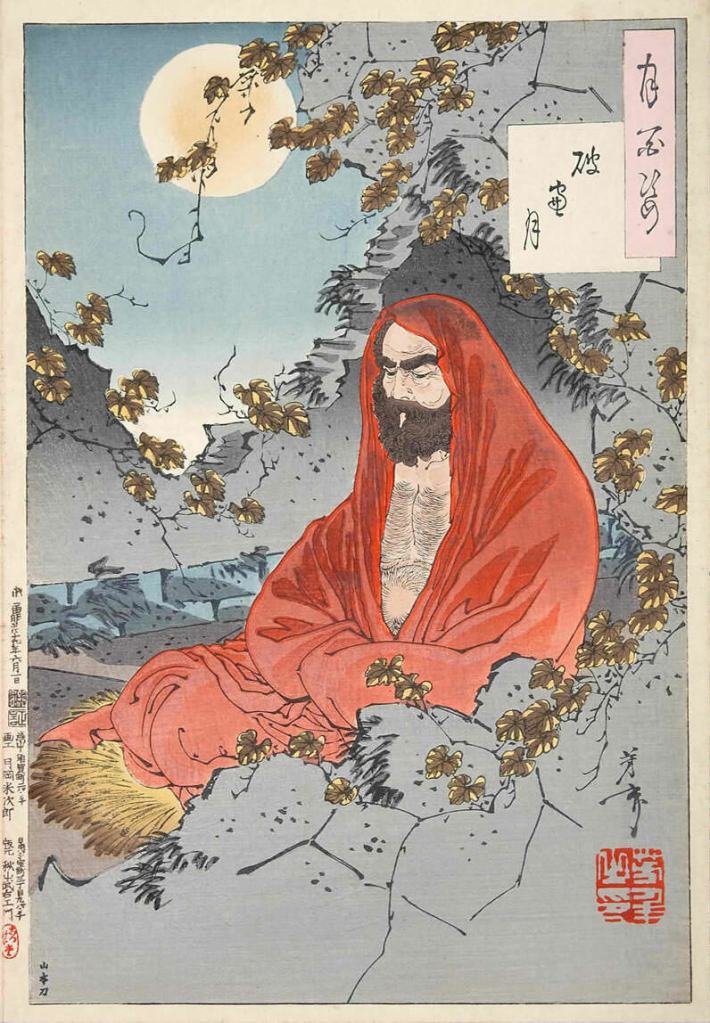
Taizong was pleased, and said, “Our ministers’ reason is sound. From this point forward, any dissenters will be punished.” He commanded Wei Zheng, Xiao Yu, and Zhang Daoyuan to elect a righteous master from all of the monks to lead the Rites. The court kowtowed to the Emperor and were dismissed. From that point a law was written, that whomever spoke ill of the Buddha or a monk was to have his arm broken.
The next day, the three advisors assembled the monks to make the selection of a righteous master. Can you guess who they selected?
In secret his name was Golden Cicada
Because he didn’t heed the teachings of the Buddha,
He was reincarnated as a human to endure suffering
Down to the world and into a net.
He was born into a life of misfortune,
To meet evildoers even before his birth.
His father the Zhuangyuan6 Chen from Haizhou,
His grandfather7 the Chief Minister Yin Kaishan.
Threatened at birth so thrown into the river,
Buffeted by the waves and carried by current
Fate brought him to the island of the Golden Mountain,8
There he was raised by the monk Qian’an.9
Reunited with his mother at eighteen,
Traveled to the capital to seek the Chief Minister.
Minister Kaishan roused the troops
Marched to Hongzhou to punish evildoers.
Zhuangyuan Guangrui so escaped death,
How happy together are father and son!
Before the Emperor they received his grace,
In Lingyan Tower their names resound.
Refused the post to be a monk,
To study the scriptures at Hongfu.10
Reincarnated Buddha named River at birth,
His religious name now dubbed Chen Xuanzang.
That day, Master Xuanzang was selected from the multitude. He had been a monk since childhood, had been vegetarian since birth. His grandfather was the current Chief Minister Yin Kaishan; his father was Chen Guangrui, who had achieved Zhuangyuan, a respected offician and scholar of profound knowledge. His heart did not seek glory, but only desired to cultivate and seek nirvana. They saw that his lineage was good, as was his character. Of the thousands of sutras and scriptures, there were none that he did not understand. Of the chants and hymns, there were none he did not know. The three advisors brough him before the Emperor and bowed, saying, “Official Yu and the others by imperial edict have selected a monk: Chen Xuanzang.”
When Taizong heard this name, he pondered it for a long time, then asked, “Are you the Xuanzang son of the scholar Chen Guangrui?”
River kowtowed to the emperor and replied, “I am.”
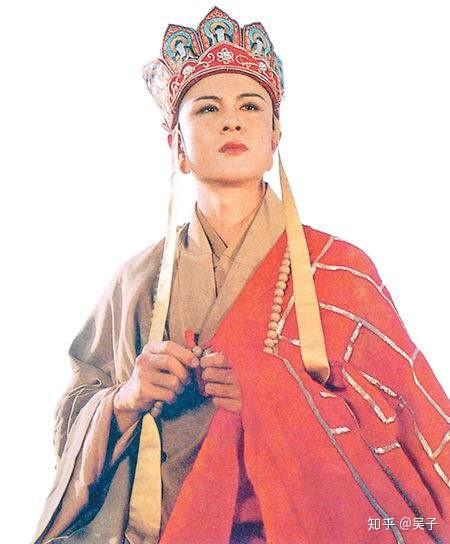
Taizong was pleased. “They have selected well. Truly what a virtuous monk with a heart for Zen. We therefore appoint you China’s Chief Priest of Zen11 Xuanzang bowed to accept the office, and received a multicolored Kasaya embroidered with gold and a sun cap.12
Forty-nine days
There are some numbers in Chinese that use the multiplication tables for emphasis. The text here doesn’t just say “forty-nine.” It says “seven seven forty-nine”, 七七四十九. We seem to really like these perfect squares, because another one used in the story is “nine nine eighty-one”, 九九八十一, the number of obstacles the crew have to overcome. In these cases, the emphasis is on completeness and religious significance. One used in modern day is in the phrase 不管三七二十一, or [he] doesn’t care [that three sevens is twenty one] about anything!
The emperor instructed him to carefully consult accomplished monks, set in order the teachers of the faith, go to the Temple of Transformation, and on the propitious day and hour, to begin the ritual. Xuanzang accepted these orders and left the palace, went to the Temple of Transformation, gathered many monks, organized the construction of the meditation platforms, and arranged the music. A total of one thousand two hundred monks were selected and arranged in three ranks throughout the hall. Everything and every person was soon in place before the Buddhas. The lucky day to begin the Grand Mass of Land and Water was selected to be the third day of the ninth month,13 lasting forty-nine days. A memorial was presented to the Emperor, who on that day, went with all of his relatives and officials, both civil and military, to burn incense and to listen to the lecture. What did the ceremony accomplish? Listen in the next chapter.
Next time, finally on to Chapter 13!
1 lol. I can’t not quote the Bible in these situations. ↩
2 unit of area = 1/15 hectacre ↩
3 Wow, feels so civilized. ↩
4 That turned into character attacks real fast. Also, thank you Dr. Yu for the translation help on this whole debate! ↩
5 Confusianism, Buddhism, Daoism ↩
6 remember, the first place in the national exam is the zhuanyuan ↩
7 maternal ↩
8 name of the monastery that took him in ↩
9 The name of the monk isn’t the same as before. Dr. Yu has a theory. ↩
10 Temple ↩
11 I am very confused. 都僧纲 is a historic rank of Buddhist monk, but ranks changed over the dynasties and I’m not sure if there is a consistent translation of this rank. It’s pretty high, but not the highest. ↩
12 Pilu cap, apparently a play on the Sanskrit word for sun, and it does look like a sun, may be a reference to Vairocana Buddha. ↩
13 by the lunar calendar. In the year of 2026, this corresponds to October 12. ↩

